The third regiment in Hawley's Brigade was the Eighth United States Colored Troops (U.S.C.T.). This unit was new and completely untried in combat, having been organized between September 1863 and January 1864 at Camp William Penn, near Philadelphia. Several companies were also raised at Wilmington and Seaford, Delaware.
The Eighth's commander was Colonel Charles W. Fribley, a native of Lycoming County, Pennsylvania. Fribley had risen from the non-commissioned officer ranks to become a captain in the Eighty-fourth Pennsylvania Volunteers. On 18 November 1863, he was appointed colonel of the Eighth by the Secretary of War.
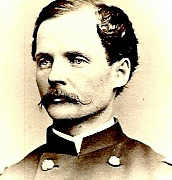
Fribley's inexperience with high rank is evident from the fact that, soon after assuming command, charges were preferred against him by the commandant of Camp William Penn, Lieutenant Colonel Louis Wagner. Wagner accused Fribley of exceeding his authority and of "obeying my orders when it suits him and disobeying when it does not suit him." The army's Judge Advocate Office eventually ruled that the charges were not sufficient to warrant a court-martial.
Most of the other officers in the Eighth were veterans of other regiments who had appeared before examining boards selecting officers for the new U.S.C.T. regiments being formed. One example was First Lieutenant Oliver Willcox Norton, formerly a private in the Eighty-third Pennsylvania, and veteran of Gettysburg and many other eastern theater battles. The Eighth's lieutenant colonel was Nelson B. Bartram, formerly of the Seventieth New York, while Major Loren Burritt had experience with the Fifty-Sixth Pennsylvania.
|
The unit's enlistees consisted mostly of free Northern blacks from Pennsylvania, some Southern contrabands, as well as inhabitants from the border states of Maryland and Delaware. Some recruits came from Indiana and, surprisingly, Jamaica. Little is known of these or other black soldiers, as the overwhelming majority were illiterate and left no personal recollections of their service.
Service records provide an outline of the lives of some of these men, who might otherwise be remembered only as statistics on a casualty report. Private Richard D. Duryee was drafted in Brooklyn, New York, on 2 September 1863. Thirty-four years old, he stood 5 feet 4-1/2 inches tall and had black hair, eyes, and complexion. Duryee was born in Pennsylvania and listed his pre-war occupation as "coachman". Promoted to corporal on 1 January 1864, he served as a non-commissioned officer in Company I. Another member of the Eighth was Elijah Little, a twenty-five year old, 5 feet 7-1/2 inch tall native of New Jersey. The yellow-complexioned Little enlisted in Philadelphia on 3 December 1863, abandoning his life as a farmer. |
"Our camp thronged with visitors, and darkees who wanted to enlist. There are hundreds of them, mostly slaves, here by now, anxiously waiting for the recruiting officer. The boys are singing--'Rally round the flag, boys, rally once again,
Shouting the battle cry of freedom.
Down with the traitor, up with the star.' "
|
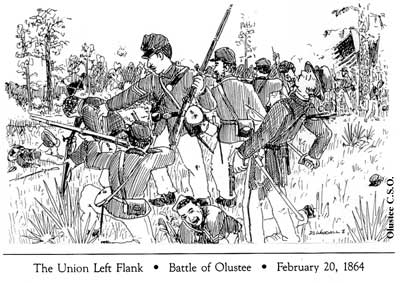
Despite its enthusiasm, the Eighth was still dreadfully ill-prepared for combat. Barely one month out of training camp, the regiment had little or no battlefield drill, and many of its troops were even unfamiliar with the proper procedure for loading their rifles! At Olustee, the inexperience of the regiment would have disastrous results.
The Eighth was thrown into the bitter fighting at Olustee largely unprepared. Colonel Fribley's death early in the battle also unsettled the recruits, but while some retreated in disorder, most stayed to fight and die. The regiment would lose 87 men killed and mortally wounded in the fighting, one of the higher death totals suffered by a U.S.C.T. unit in the war, while its total casualties numbered 310.
A letter written by 1st Lieutenant Oliver Willcox Norton detailed what happened when troops of his Company K marched near a strategic railroad line. (Other letters by Norton concerning the Battle of Olustee are available below.)
In August 1864, the Eighth was ordered to Petersburg where it joined the Army of the James and fought gallantly at Chaffin's Farm and Darbytown Road. The 7th and 8th United States Colored Troops were the first two Union regiments to enter Petersburg when the city fell.
By the end of the war, the regiment numbered third among the 166 black regiments in terms of combat losses. It was mustered out in November 1865, after doing duty in Texas as part of the force sent there to convince France to pull its troops out of Mexico.
"There have been men who have proposed to me to return to slavery the black warriors of Port Hudson & Olustee to their masters to conciliate the South. I should be damned in time & eternity for doing so." - Abraham Lincoln, 19 April 1864 (Collected Works 7: 506-507)
Report from Capt Romanzo C. Bailey commanding 8th USCT after the battle
Report from Lt Andrew Ely
Report from Lt Elijah Lewis
Offical History of the 8th United States Colored Troops
Photograph and short history of Col Charles Fribley
Photograph and short history of Maj Loren Burritt
Letter from A.P. Heichhold, Surgeon, 23 February 1864
Letter from Sgt Major Rufus Jones, 24 March 1864
Letter from Sgt Major Rufus Jones, 16 April 1864
History and diary of Pvt William Woodlin, Company G
Excerpt on the 8th U.S.C.T. from the book The Black Phalanx
Letter from Lt Oliver Norton, acting regimental quartermaster, 29 February 1864
Letter from Lt Oliver Norton, acting regimental quartermaster, 1 March 1864
Letter from Lt Oliver Norton, acting regimental quartermaster, 9 March 1864
Letter from Lt Oliver Norton, regimental quartermaster, 14 April 1864
Pvt Oliver Norton, bugler (83rd Pennsylvania Volunteer Infantry)
History and Photographs of Oliver Norton by Jari Villanueva (PDF file posted here with his permission.) - comprising pages 15-21 of Villanueva's Twenty-Four Notes That Tap Deep Emotions: The story of America's most famous bugle call
External Web sites related to the Battle of Olustee
History of the 8th U.S.C.T.
LtCol Samuel Armstrong - commanding officer 8th U.S.C.T. later in the war
The Story of the U.S. Colored Troops
Database of United States Colored Troops
Eighth U.S.C.T. page on the U.S.C.T. Colored Troops Web site
Free online book - Army Letters 1861–1865 by Oliver Willcox Norton
Reference Books on the 8th U.S.C.T.
8th United States Colored Troops - Company B - Pinellas County, Florida
Union Order of Battle
Battle of Olustee home page
http://battleofolustee.org/
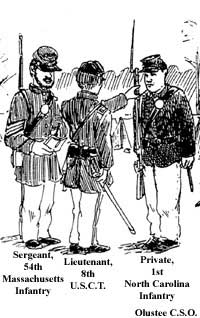 Drawing from the